Recap: Museum Ambassadors Community Day

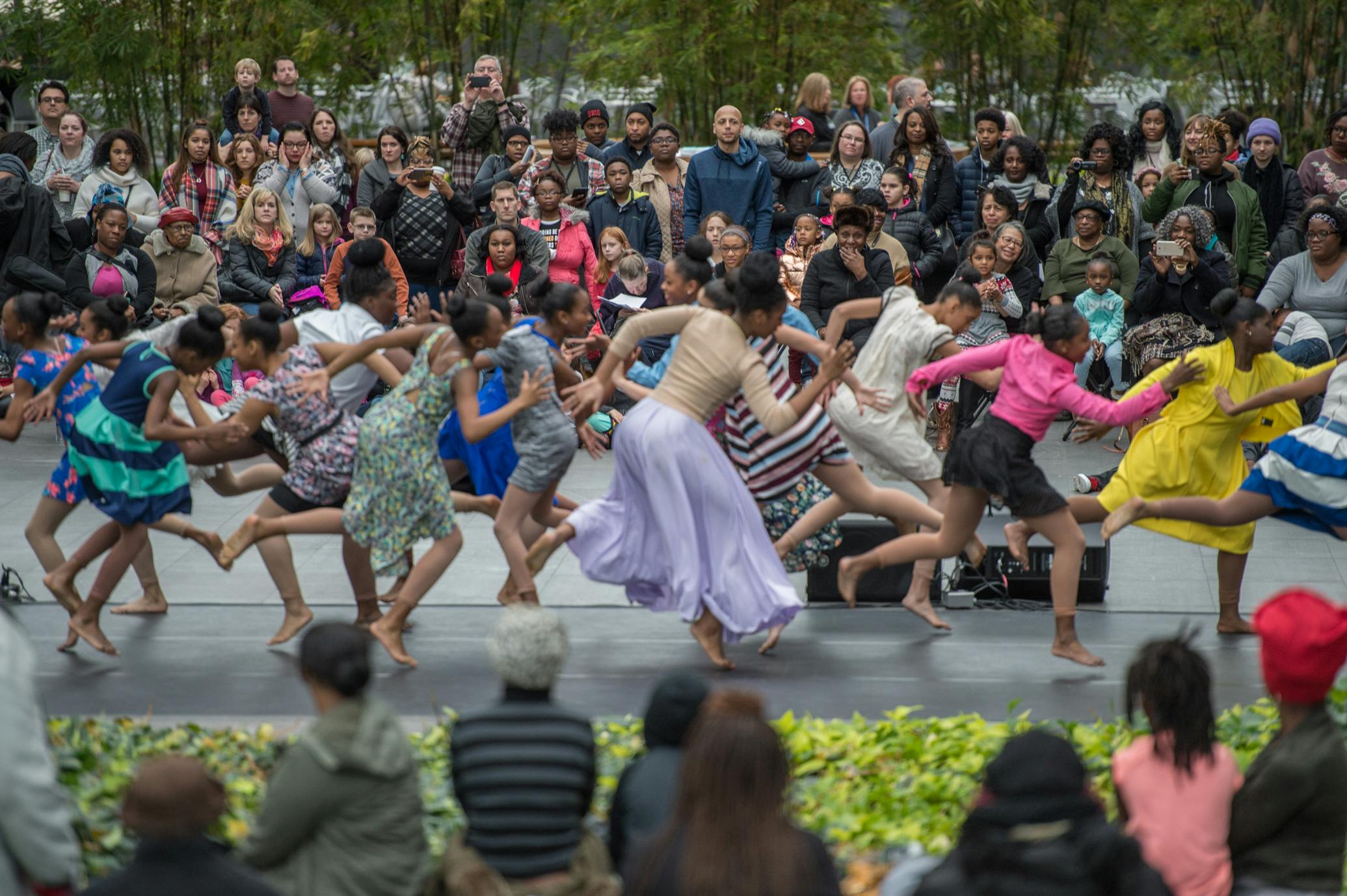
Each spring, high school students from the Museum Ambassadors program facilitate a Family and Community Day for the public. Hailing from all corners of the Cleveland area, these 10th-12th graders create projects summarizing their experiences at the museum during the past school year. Prior to the April 29th Community Day, students met with museum staff, planned an activity for visitors, and marketed the event in their schools and communities. This year more than 800 visitors participated.

Students from Bedford High School designed studio projects based on four of their favorites from the collection: Gamin by Augusta Savage, Marilyn x 100 by Andy Warhol, The Dream by Salvador Dali , and Turtle Baby by Edith Barretto Parsons Stevens.

During the program year, students develop supporting relationships with their fellow Ambassadors. Students from CASTLE High School enthusiastically participated in the other schools’ activities.

Ambassadors from Strongsville High School were inspired by our current exhibition, Rembrandt in America. These students designed a portrait-painting activity for visitors.

Students from Shaker Heights High School researched ancient Egyptian head ware and worked with visitors to make one of three types of Egyptian hats.

Shaw High School Ambassadors explored the connections between art and music. After painting to different types of music, visitors created frames to hang their works.

Cleveland School of the Arts students asked visitors to design their own installations using groupings of artworks in a mock gallery.

Valley Forge High School Ambassadors explored symbolism in painting and developed a tour for visitors. Students dressed in costume and presented the tour as figures from paintings in our European collection.

Posted in Community Engagement, Education, Museum Staff, Visitor Experience | Tagged , , , , , , , , , , , , , | Comments Off
 

Behind the Scenes: Meet Mel Horvath

Chances are that if you have been to the museum in the last 30 years you have intersected the work of Mel Horvath. Horvath is one of the men behind all the brochures, flyers, and programs. He also runs the museum copy center. He’s a friendly face around the museum and is known for his knowledge of the people that have worked here over the years and his colorful bulletin board of some of their children.

Q1: How long have you been a staff member at the museum?
A: I first came to the museum to work in the print shop in 1972. I met my wife here and back then they had a rule where spouses could not work here. So I left and came back in 1979 and the rule changed a little later.

I have been here ever since. In 2008, the print shop closed. We use a high-grade copier to produce many things, but the quality is excellent and our customers are happy. Now, we are leaner, smarter, and we can print on demand. We’ve changed the way we think about what we print and the need for print.

Q2: What are you printing this week?
A: We are always busy. This week we are printing 400 invitations for a special donor event, label copy for our next exhibition so that our docents can study it, and a brochure for one of our affiliate groups and a save the date card for our Textile Art Alliance Fashion Show in October.  And…I have to be ready for new print jobs as they come up. They always do.

Q3: What do you enjoy most about your job?
It‘s different every day. I enjoy the problem solving. I also enjoy that I get to put smiles on people faces by just making a delivery.

Q4: What do you print?
A:  Some things we print here, some we send out of house. Almost everything goes through my shop except the Cleveland Art magazine for members and the exhibition catalogues.

Q5: Do you like art? Are you an artist?
A: I enjoy watching the people who do like art. The kind of art I like is cars and working with my hands. There is craftsmanship and artistry in almost everything.


Posted in Museum Staff | Tagged , | Comments Off
 

Rembrandt in America: Drawings

Rembrandt drew to hone his skills, record a motif, test compositional ideas and ways of expressing emotion, and provide instructive models for his students. Upon his death, nearly 2,000 drawings by Rembrandt and his followers were found in his studio. Intended for workshop use, the teacher’s drawings are rarely signed. It is a special occasion to see the four drawings on view in Rembrandt in America. Because drawings, like all works on paper, are light sensitive, so they can only be viewed for limited amounts of time.

The drawings complement the theme of questioning attribution/learning to look critically, because two of them may not be by Rembrandt.

“I had the opportunity to meet with the preeminent scholars on Rembrandt drawings in 2009 and discuss the latest thoughts on The Meeting of Christ with Martha and Mary after the Death of Lazarus and Christ Taken before Caiaphas,” Heather Lemonedes, Curator of Drawings said. “It is believed that Christ Taken Before Caiaphas of them is by a follower of Rembrandt.”

Christ Taken before Caiaphas

Lemonedes says visitors can learn a great deal about Rembrandt’s style from viewing these drawings.


“Rembrandt communicates a vast range of human emotion in these drawings. When I study them, I see figures expressing apprehension, tension, loving care, anticipation of pain and patience. With just a few lines, Rembrandt portrays the complexity of human interaction.”

Rembrandt in America is on view through May 28.

Kesha Williams


Posted in Exhibition | Tagged , , , , | 1 Comment
 

Preview: Solstice 2012

The region’s premier summer music festival is just two months away.  Tickets are now on sale for Solstice!  The Cleveland Museum of Art invites the community to celebrate summer’s long days and hot nights at Solstice on Saturday, June 30 from 7:30 p.m. to 2 a.m.

Enjoy global cosmopolitan music throughout the night on the main stage, get a sneak peek of the Youth and Beauty: Art of the American Twenties exhibition and explore the permanent collection late into the night. From grooving to Ethiopian funk to rocking with Afro-Peruvian electronica, festival-goers will have the chance to see some of the most cutting-edge international musical acts performing today.

ADMISSION:

  • From 7:30 p.m. until 2:00 a.m., general admission is $60 per person, $30 for museum members.
  • From 10:00 p.m. until 2:00 a.m., general admission is $25 per person.

* Food and drinks will be available for purchase at Solstice all night long.

This event sells out every year, so don’t delay on securing your access to a great and unique evening at the museum.

Purchase tickets, get the music lineup @ http://goo.gl/nnD4P

Sponsored by Great Lakes Brewing Company, Dix & Eaton, Thompson Hine LLP and Column & Stripe: The New Friends of the Cleveland Museum of Art.


Posted in Museum Staff, Summer Solstice | Tagged , , | Comments Off
 

Collection Highlight: A “Wow” Moment in Gallery 207

This magnificent walnut sideboard makes quite the focal point in Gallery 207 where it is currently on display. Its highly-detailed carving, wealth of imagery, and massive presence seems to say the following about its owner- “I’ve got money-and taste-!” It’s also a great stop for a tour with school-age children because there are so many details on which the eye can focus- for instance, the dog-head door pulls, identified as Brittany-Spaniels and Short-Hair Pointers;

the bountiful game animals

and the crowning element, a hawk seizing a partridge.

However, to me, the most interesting elements of the composition are the depictions of Native Americans on the sides of the counter top.  When Native Americans appear as subject matter in 1800’s art, their inclusion can stem from a documentary impulse (like George Catlin’s 1830s portrait series) or a Romantic sympathy (like James Earl Frasier’s The End of the Trail, 1894); but here, these half-naked figures seem to glare at us with suspicious air that seems less than sympathetic. I had to pause for a moment and think: would the sideboard’s attributed sculptor and cabinetmaker, Joseph Alexis Bailly, have even seen anyone looking like this on the streets of 1850s Philadelphia? Doubtful. By the mid-1800s Native Americans of the mid-Atlantic region, having been subjugated to the “civilizing” influence of whites for centuries, had adopted settler dress, language, and religion and taken elements of their own culture underground in order to survive. The Native men flanking the Cleveland Museum of Art’s sideboard, although wearing certain elements of Woodland people’s traditional dress such as the gustoweh and moccasins, would have largely been a fiction of the artist’s imagination by that time.

And indeed it turns out they were meant to be allegorical figures, certainly not portraits or even renderings of a specific type of Native person.  According to Stephen Harrison, Curator of Decorative Arts, this sideboard makes reference to a sideboard that was on view at the 1851 Great Exhibition in London (the one for which the Crystal Palace was built) which featured allegorical figures of Europe, Asia, Africa, and America in about the same location of the composition.  In the eyes of Europeans, Native Americans were about as New World as you could get; and so were often used as allegorical figures for the Americas. Their inclusion on the sideboard “Americanizes” the work.

If the composition could be summarized as “American abundance”, the subject was timely for the mid-1800s. America was beginning to experience the financial ramifications of the newly emerging Industrial Revolution. The men who would have backed inventions- such as railroads, telegraphs, and processes for refining petroleum- were the type of men who could have afforded such a piece and may have been the cabinet maker’s intended consumer. Money doesn’t always buy taste, but it seems safe to say this sideboard’s original owner must have had both in abundance.

Alicia Garr

Posted in Collection, Uncategorized | Tagged , , | 1 Comment
 

Rembrandt in America: Through a Child’s Eyes

Maya Meets Mommy’s Latest Assignment

Excited to showcase the great Dutch artist Rembrandt van Rijn to my four year old, Maya, I decided to bring home the catalog for the exhibition.  For Maya, flipping through exhibition catalogs is as commonplace as reading an Eric Carle book.  We sat down one the bed, and I said, “Tell me what you think.”

After a decade working with the public, I would like to say that I was prepared to hear whatever answer she gave.  But, I can’t.   After flipping through the book, Maya said, “It’s boring.”

Surprised and dismayed, I said, “Do you think the people looked bored?”

“I don’t know.  It’s boring.”

It is worth saying that I have taught in the museum’s Dutch galleries for years.  I sat on the committee as these galleries were being installed.  So, basically, my kid was telling me one of my professional labors was a bore.  Luckily, laughing is my tried and true coping mechanism.

After my chuckling subsided, I regrouped.  And, I said, “That’s okay.  Actually, I think the opposite.  Can I show you some things that I like about these paintings?”  We spent a few minutes looking and talking about some of my favorite paintings.

The one big lesson here is one that parents, including me, sometimes forget that we all like different things— and that is okay. I can’t express how much my 2 year old loved The Lure of Painted Poetry.   For Maya, the best exhibition to date was Treasures of Heaven, a show that had shiny objects and interesting hairstyles.   Liking art doesn’t imply that you have to like all art.

On Piquing Children’s Interest

A young visitor playing dress up

The next morning, in the car, Maya mentioned, “You know, why did his wife have a globe on the table?”  There is that saying about developing children’s palates that they need to taste it many times.  Sometimes it is about piquing the children’s interest.  First, you have to make it relevant.  My daughter loves dressing up.  In many ways the sitters in the portraits in the exhibition were playing dress up; they were using their adornment as way to define themselves.

Relevancy is often tied with familiarity.  Small factoids or bits of information can be empowering to anyone learning about art, especially children.  For example, I had told my daughter that the model for Minerva might have been Rembrandt’s beloved wife Saskia.

In the galleries, when the show opened, Maya and I went to see the art in person.   I promise you, no photograph, no matter how good, can rival the actual painting.   That frilly lace looks like dots and squiggles close up.  The portraits almost seem to breathe—and close up there isn’t a trace of brushstrokes.

When Maya got up to Flora, she saw a kindred spirit.  There before her was a woman dressed in a billowing shirt and rich yellow silken skirt.  And, then there was the je ne sais quoi of the flowery hat.

The Power of Inspiration

For young hands, art museums can be a challenge.  Children want to do.  Our museum offers children’s classes during the week and on Saturdays to can satiate that urge.  But, we also make things at home.  Even the art averse can write (and even illustrate) the story of their visit to the museum. Collage is an easy way to create a product that looks finished but requires almost no drawing ability.

A young visitor making a collage

In this case, Maya wanted to make her own Flora.  I sketched a template, which Maya decorated.  The project use basic items like glue, colored pencils, fabric, and straws.

Creating can help kids make sense of what they have seen.  In this case, we talked about how Flora was different than the other women in the exhibition.  Unlike the formal portraits, Flora was wearing light colors.  Dutch women did not wear flamboyant hats as Flora does.  Flora was not meant to be a portrait but instead a picture of a mythical being, a personification of nature.

After all that, I let Maya be free to design.  Because, the goal isn’t that she experiences rather than reproduces Rembrandt.

While I wanted to ask Maya what she thought of the show, I had learned my lesson.  The other day, though, she said, “Hey how is Rembrandt?  I really like Flora.”  I guess that Rembrandt guy isn’t a bore after all.

- Seema Rao


Posted in Children and Families, Exhibition, Visitor Experience | Tagged , , , , , , | 1 Comment
 

1,000 sheets of paper, 30 boxes of markers, 79 students + you

Spring is in the air, and that means it’s time for another Museum Ambassadors Community Day this Sunday! At the end of each spring semester, our high school Museum Ambassadors present student-led tours, scavenger hunts, and studio activities summarizing their experiences at the Cleveland Museum of Art over the past year. While the public only gets to see the culminating event of the program, a lot of work goes into this one day.

Julia Maranto, one of our interns, summarized the part you don’t get to see:

So what do 800 cookies, 73 volunteers, and 128 bus rides get you? Stop by from 1-4 p.m. on April 29th to find out!

Hajnal Eppley

Posted in Children and Families, Community Engagement, Education | Tagged , , , | Comments Off
 

Member Profile: 20 Years of Participating in Parade the Circle

Every spring, Sawsan Alhaddad looks forward to the Cleveland Museum of Art’s Parade the Circle. She has participated in the event for more than 20 years. She started to participate when her daughter Sarah was six years old and it’s been an annual tradition for them since. They only missed last year because of Sarah’s wedding.

“For us, it always meant that summer has started. The Parade was the first thing she did when school was out. She gained confidence by participating in the Parade each year. We have a lot of great memories.”

Alhadadad, an anesthesiologist, first visited the museum in 1979 when she began working at the Cleveland Clinic. She’s been a supporter and member of the museum for many years.

She and her daughter have made varied costumes over the years. One year she remembers helping her daughter’s school group create a coral reef environment out of large batik panels. The children dressed as all the animals you’d find in that environment, including mermaids, of course. Two years ago, she collected lots of plastic packaging from medical supplies to create a large phoenix with moving wings.

Sawsan explaining different parts of the Phoenix to a participant

“It’s wonderful to see all sorts of people participating. People from different cultures and with different art skill levels all come together.  Everyone does what they like. It’s really wonderful to see kids get the chance to be creative and make art. It’s a lot of fun. ”

Join in on the fun. Learn how to create costumes for this year’s Parade the Circle through one of our parade workshops. Artists assist participants in making masks, costumes, and giant puppets using papier-mâché, cloth, and recycled materials. Public workshops begin May 4 and continue until the parade on June 9.

Get cost details and workshop times @ http://goo.gl/XUuxo

Kesha Williams

Posted in Children and Families, Community Engagement, Parade the Circle | Tagged , , , , | 1 Comment
 

On View: Relational Hangings in Reid Gallery

While our contemporary galleries are being re-imagined and reinstalled, the first of new relational art pairings are now featured in the Reid Gallery.

Contemporary works are placed in the midst of galleries of historical art to encourage questions and ignite conversation among our visitors about the relationships between periods.  The juxtapositions deviate from the chronological layout of the museum galleries.  The pairings propose relationships among works that do not refer to one another directly, yet may have cultural trends, creative ideas, and formal expressions that resonate in the present.

Firebird

Richard Hunt’s Firebird (1975) is a sculpture formed from welded steel that has been placed in the middle of the gallery. The abstract bird is made from Corten steel and symbolizes the link between nature and urban, industrial society. It has not been on view at the museum for many years.  Firebird is placed adjacent to a sculpture by Massimiliano Soldani, Apollo and Daphne, dated around 1700.

Apollo and Daphne

Made 250 years apart, both sculptures elaborate on the imagery of flight and express the notion of metamorphosis, in which continuous mutation is the motor of life. Soldani’s vigorous rotation and thrust is echoed by Hunt’s simplified volumes and a composition that defies balance, inviting viewers to move around the sculpture.

Relational art,” a term coined by curator Nicholas Bourriaud, stands for the social experience art offers when conversations occur among viewers when stimulated by these kinds of pairings. Does this contemporary work look the same to us when compared directly to the work of earlier artists? What kind of transformation or test does each object undergo? What can we learn about evaluating works of art and placing them in a museum?

Visitors are invited the see the works in these new ways.

“Art in museums has a social aspect,” Paola Morsiani, curator of contemporary art, said. “It’s not just about the art. We’re inviting people to be in conversation with the work and be in conversation about the work. It’s a different way of connecting the diversity and richness of the collection following a different system that is not chronological. The system is more based on the proper language of art, forms and ideas.”

Visitors will find another pairing toward the back of the galleries.

Soft Borders

Interior of the Pantheon, Rome, dated 1747

The relocation of Mark Tansey’s Soft Borders, dated 1997, invites a specific comparison with Giovanni Panini’s Interior of the Pantheon, Rome, dated 1747.  Both paintings articulate how the present relates to the past. The contemporary life shown by Panini may seem long gone, but the questions he raised about the role of history resurface in Tansey’s recent picture.

These juxtapositions were suggested by Christian Black, a 2011 curatorial intern from Miami University, Oxford, Ohio. Black brought a different perspective because he is a philosophy major.  Jon Seydl, The Paul J. and Edith Ingalls Vignos, Jr. Curator of European Paintings and Sculpture (1500-1800), believes that both pairings make striking statements in the gallery.

“These relational hangings are not only about the curators generating ideas about what these relationships mean,” Jon Seydl said. “We really want our visitors to generate the ideas themselves.”

Kesha Williams

Posted in Collection, Museum Staff | Tagged , , , , , , , , , , , , , , , , | 1 Comment
 

A Salute to Our Volunteers

April is National Volunteer Month. We could not be one of the nation’s top art museums without the assistance of our volunteers.

“Our volunteers are special to the museum, especially during the past six years of expansion and change,” Liz Pim, Volunteer Manager said. “They help people find their way and always greet our visitors with a warm welcome. They help in other ways too – educating our public, ushering for performing arts and film, directing (or redirecting) guests, assisting with audio tours, and supporting our events.  They are a valuable part of our team.”

More than 600 volunteers gave more than 60,000 hours of their time to the museum in the past year.

Volunteer contributions range from assisting visitors at the information desk and helping prepare special events to working at the annual Parade the Circle, serving as docents for school groups, and assisting in curatorial projects. These volunteers include high school students to college interns, community leaders to retirees.

See our volunteers at work.

Interesting in joining them? Details @ http://goo.gl/BVTKS

Posted in Community Engagement | Tagged | Comments Off